
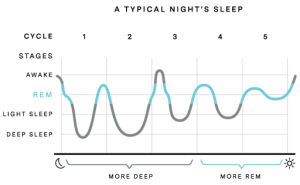
Sleep architecture refers to the patterns of brain activity and physiological changes that occur during sleep. Typical sleep architecture consists of several stages, each characterized by different brain wave patterns and associated with various levels of physical and mental activity. Each cycle lasts about 90 to 120 mins, repeating 4-6 times per night. Here’s a breakdown of the stages:
Stage 1 (Light Sleep): This is the transition from wakefulness to sleep. It’s a light stage where you may feel drowsy and can be easily awakened. 5-10 mins.
Stage 2 (True Sleep): A deeper stage of sleep where brain waves continue to slow down. It’s harder to wake someone up during this stage. 20mins per cycle.
Stages 3 (Deep Sleep): The deepest and most restorative stage of sleep, crucial for physical recovery, growth and repair. Hormonal regulation and immune function. Contributes to feeling physically energised in the morning. Deep sleep lasts about 20-40 mins per cycle ideally for a total of about 25% of your time asleep.
REM Sleep: Is characterised by Rapid Eye Movements, increased brain activity, vivid dreams and faster breathing and immobile muscles. This stage is important for cognitive functions, emotional regulation, mood and mental clarity. Get longer in later cycles of the night. REM sleep lasts from 10 – 60 mins per cycle ideally for a total of about 25% of your time asleep.
Amount of sleep varies by age group, but most adults are recommended between 7 and 9 hours per night.
Sleep disturbances
As people age, changes in the brain chemicals that regulate sleep patterns and quality are common. Some people have difficulty falling asleep while others wake up frequently and find it hard to get back to sleep. Some unlucky people have both … resulting in fragmented and less refreshing deep restorative sleep. Leading to physical and mental issues.
Other factors such as chronic pain, the need to use the bathroom, restless legs, menopause, noise disturbances, sleep apnea, jet lag, shift work, interruptions from children, pets, partners or noises can all play a part in causing sleep disturbances.
It’s a wonder anyone gets a decent sleep!
Most people with disturbed sleep have usually tried all the common sleep hygiene advice: about caffeine, morning daylight exposure and exercise, maintaining a consistent sleep schedule, reducing screen exposure, etc. However, after trying all the above, many people still can’t get the long deep sleeps they yearn for.
Commonly, people resort to pharmaceutical medications. While effective in the short term, the medium term can produce progressive tolerance, causing reduced effectiveness and need for higher doses and disturbance of sleep architecture and rebound insomnia once ceased.
Before getting into the use of cannabis, there are a few ideas I would like you to consider and a few skills to try. In general, the more skills you have the more likely you are to improve your sleep.
Stop trying to sleep!
Unfortunately, the harder you try to sleep the harder it is to fall asleep. Sleeping is out of your control, you cannot make yourself fall asleep, the more frustrated or anxious you become about not sleeping, the more awake you become. That vicious cycle is familiar to insomniacs. leading to chronic sleep anxiety.
Ways of drifting to sleep
We don’t so much fall asleep as drift to sleep.
If you find yourself unable to fall asleep and/or unable to get back to sleep, you could, as some people do, get out of bed and do something else. Reading, watching TV, writing or having a cup of hot milk or herbal tea can be helpful.
Broadly, the idea is to shift your aim away from trying to sleep and instead focus on relaxing your body, quietening your mind and soothing your emotions.
Think of it as having mindful rest.
Sleep tracking apps
Usually, our subjective evaluation of time asleep is inaccurate. Sleep trackers can help by giving you feedback about your sleep cycle. A sleep tracker is like doing your own regular sleep study at home without the expense of a formal sleep study. Maybe not as detailed but good enough for our purposes.
Sleep trackers rely on movement, sound or physical measurements. My favourite is Sleep Cycle from the App store (U$48.99 per year). There are others, check out: Shuteye, Sleep Score, Oura rings, to name few.
There are also smart watches that also track your sleep and give you feedback.
Sleep trackers will help you regulate your hours of sleep and timing of your dose of cannabis.
‘Sleep Cycle’ app
- Will assist you with sleep regularity by tracking your time to bed and time to rise and length of sleep.
- Will also produce a graph of your sleep architecture with information about time to get to sleep, time in deep sleep and time in REM sleep.
- Will also track your breathing pattern and record any snoring & coughing sounds.
- Compares your results over time and with others in Australia and overseas.
- Includes options for sleep music, relaxation guides, sleep stories and AI generated analysis.
Cannabis-assisted sleep
- Research findings: Among long-term cannabis users, about half use cannabis to improve their sleep. Among people who use cannabis for medical reasons, such as pain relief, as many as 85% say it improves their sleep as well.
- Potential effects: Cannabis may help you fall asleep faster and wake up less often during the night. It may also ease the ‘busyness’ of your mind with softer or fewer unsettling thoughts
- Considerations: While cannabis may help relieve insomnia when used correctly, excessive doses may negatively influence sleep by causing over stimulation later in the night.
The effects of cannabis vary depending on the individual’s biology and prior cannabis history. Variables include product, dose, timing and method of administration. Cannabis taken as an oil, under the tongue, has an effect lasting about 8 hrs. and takes about 1-2 hours to start working, so for those people who have difficulty falling asleep, it needs to be taken about 1-2 hours before planning to sleep. Cannabis can also be inhaled either as dried flowers or from vaping cartridge. Inhaled cannabis works in 10-15 minutes and lasts 2-4 hours which is useful to fall asleep more quickly or to get back to sleep in the middle of the night.
The correct dose of cannabis varies for each individual and if it is too low it will not achieve the desired effect and if too high may produce unpleasant effects such as over stimulation or very dry mouth.
Benefits of cannabis for sleep
- Falling asleep: Cannabis is known to have sedative effects, which can promote relaxation and help individuals unwind before bedtime. This can be especially beneficial for those who have difficulty falling asleep due to mental or emotional over activity.
- Prolonging deep sleep: Cannabis has been found to potentially increase the amount of time spent in deep sleep which is crucial for physical and mental restoration and recovery.
- Staying asleep: Cannabis can reduce the number of times you wake at night or to help you go back to sleep more quickly if you wake for any reason. You can expect to wake up feeling more rested, relaxed, and mentally refreshed
- Regulating REM sleep: Cannabis can also affect REM sleep, it has been shown to decrease the intensity of REM sleep and the quality of dreams. This can be beneficial for people who experience nightmares.
Tolerance breaks
To reduce the likelihood of developing tolerance and needing progressively higher dose, it is recommended that you stop using cannabis for at least 2 consecutive days per month. That resets your cannabis receptors, enabling you to benefit from the same dose long term. And you may be able to reduce the dose or have nights when you sleep well without cannabis.